

 SEARCH

AI Visibility Optimization Meets Search Engine Optimization

December 4th, 2025
posted by Radomir Basta to AI SEO agency, AI SEO company, AI-powered SEO services, best AI SEO companies, conversational search
Enterprise leaders face a split reality. Traditional keyword search still drives qualified traffic, while conversational AI systems now surface answers before users reach your site. Running only one channel leaves demand on the table.
Search behavior has fractured. Users type intent-rich queries into Google while asking open-ended questions to ChatGPT, Perplexity, and SGE. Treating AI SEO as a replacement for traditional methods risks cannibalizing proven channels and missing new discovery opportunities.
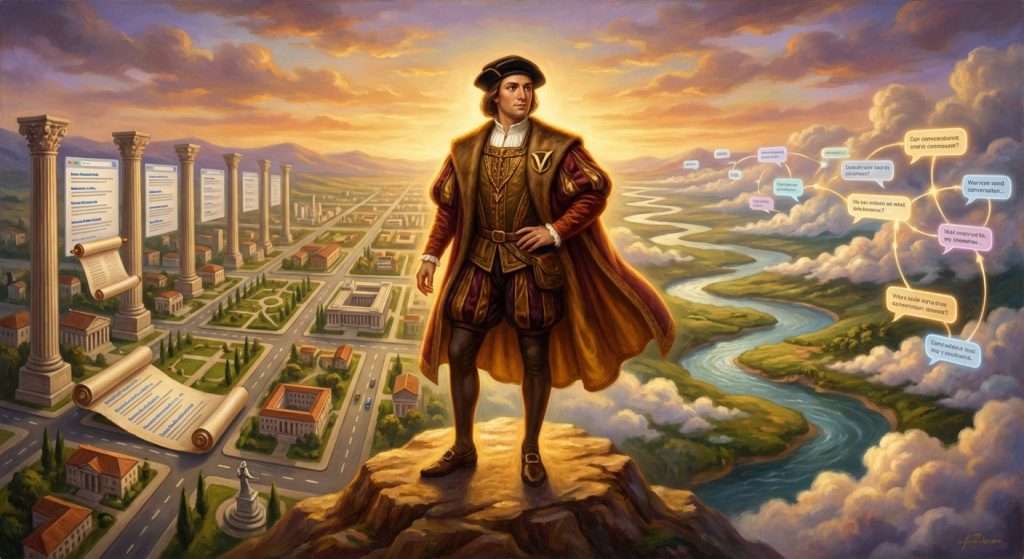
The solution: operate both rails in parallel. Build distinct signal strategies, KPIs, and workflows for AI discovery and traditional search, coordinated by one technical foundation and unified content architecture.
As a New York AI SEO agency, we deliver AI-powered SEO services that augment enterprise AI SEO roadmaps and support an AI-driven SEO strategy.
Four Dots applies a forensic audit methodology and operates AI-assisted workflows built around proprietary tooling. Our white-label SEO approach treats traditional and AI search as complementary operating systems, not competing priorities.
The Shift: Addition, Not Replacement
User behavior now splits across two distinct patterns. Some visitors type specific queries and scan blue links. Others ask conversational questions and trust generated answers.
This split creates two discovery platforms:
- Classic SERPs – keyword-driven results with rankings, snippets, and click-through rates
- AI answer engines – conversational interfaces including SGE, ChatGPT, Perplexity, and voice assistants
- Hybrid experiences – search results pages with embedded AI-generated overviews
The implication: expand your surface area. Reallocating 100% of budget from traditional SEO to AI experiments abandons proven revenue while chasing unproven channels.
Why Both Channels Matter Now
User journeys rarely follow single paths. A prospect might discover your category through an AI-generated comparison, then search your brand name directly to evaluate credibility. Another might land on your site through organic search, then ask ChatGPT to explain your differentiators.
Mixed-intent queries compound the challenge. Questions like “best enterprise CRM” trigger both traditional results and AI overviews. Occupying only one format means competitors capture the other half of that demand.
Category creation and mid-funnel education increasingly happen through AI answers. When prospects ask “how does X work” or “what should I look for in Y,” conversational systems provide the first explanation. Missing from those answers means missing from early consideration sets.
How They Differ: Signals, Mechanisms, Measurement

Traditional SEO and AI discovery operate on fundamentally different systems. Understanding these differences prevents strategy conflicts and measurement confusion.
Signal Differences
Traditional SEO signals include:
- Backlink authority and anchor text diversity
- Keyword targeting and semantic relevance
- Site structure and internal linking architecture
- User engagement metrics (CTR, dwell time, pogo-sticking)
- Domain authority and trust signals
AI discovery signals prioritize:
- Entity recognition and knowledge graph connections
- E-E-A-T vectors (experience, expertise, authoritativeness, trustworthiness)
- Structured data markup and schema implementation
- Content comprehensiveness and source attribution
- Conversational query matching and natural language patterns
Mechanism Differences
Traditional search follows an index-and-rank model. Crawlers discover pages, indexers catalog content, and ranking algorithms order results based on relevance and authority signals.
AI systems use a retrieve-and-generate model. Vector search identifies relevant sources, large language models synthesize information, and generation algorithms produce contextual answers. The process bypasses traditional ranking entirely.
Measurement Differences
Traditional SEO tracks familiar metrics:
- Keyword rankings and position changes
- Click-through rates from search results
- Direct conversions attributed to organic traffic
- Page-level performance and engagement
AI discovery requires different measurement frameworks:
- Answer visibility and source citation frequency
- Assisted conversions and multi-touch attribution
- Brand lift from AI exposure
- Entity recognition and knowledge panel presence
Conflating these metrics creates false conclusions. A page ranking #1 for a keyword might generate zero AI citations. Conversely, content frequently cited in AI answers might rank outside the top 10.
Where Traditional SEO and AI Discovery Overlap
Despite operating on different mechanisms, both channels share critical technical foundations. Neglecting these shared elements undermines performance across both rails.
Technical Health Requirements
Crawl accessibility affects both traditional indexing and AI content retrieval. Broken robots.txt rules, orphaned pages, and redirect chains prevent discovery regardless of channel.
Site speed and Core Web Vitals impact user experience across all touchpoints. Slow-loading pages hurt traditional rankings while degrading the quality signals AI systems evaluate.
Mobile responsiveness remains non-negotiable. Both search crawlers and AI systems prioritize mobile-optimized content, reflecting actual user behavior patterns.
Structured Data and Entity Management
Schema markup bridges both worlds. Traditional search uses structured data for rich snippets and enhanced SERP features. AI systems rely on schema to understand entities, relationships, and factual claims.
Key schema types for dual-rail optimization:
- Organization schema – establishes entity identity and authority signals
- Article schema – provides publication metadata and authorship attribution
- FAQ schema – surfaces directly in both traditional snippets and AI answers
- HowTo schema – structures procedural content for step-by-step retrieval
- Product schema – enables detailed comparisons across both channels
Entity linking strengthens knowledge graph connections. Consistent NAP (name, address, phone) citations, Wikipedia references, and Wikidata alignment help both traditional and AI systems understand your business context.
Content Quality Foundations
High-quality, experience-led content performs across both channels. Traditional SEO rewards comprehensive coverage and user satisfaction. AI systems prioritize authoritative sources with clear attribution and factual accuracy.
E-E-A-T principles apply universally. Demonstrating experience through case studies, showcasing expertise via author credentials, building authoritativeness through citations, and maintaining trustworthiness with transparency all strengthen dual-rail performance.
Authoritative backlinks remain valuable. Links signal credibility to traditional algorithms while providing source validation for AI retrieval systems. Quality link profiles benefit both discovery mechanisms.
How to Run Both Rails in Parallel
Operating dual channels requires separate roadmaps with coordinated execution. Treating them as one program creates resource conflicts and measurement confusion.
Separate Roadmaps, Shared Backlog
Maintain distinct strategic plans for each rail:
- Traditional SEO roadmap – keyword expansion, link building campaigns, technical debt reduction
- AI discovery roadmap – entity optimization, conversational content creation, schema expansion
- Shared initiatives
Use a unified backlog to coordinate dependencies. Technical improvements often benefit both channels, while content initiatives may target specific discovery mechanisms.
Distinct KPIs and Dashboards
Track performance separately to avoid attribution errors:
Traditional SEO dashboard monitors:
- Keyword rankings and visibility scores
- Organic traffic and conversion rates
- Click-through rates from SERPs
- Page-level engagement metrics
AI discovery dashboard tracks:
- Citation frequency in AI-generated answers
- Entity recognition and knowledge panel presence
- Assisted conversion attribution
- Brand mention sentiment in AI responses
Cross-reference dashboards to identify crossover effects. Traffic from branded searches often follows AI exposure, while traditional rankings can boost entity authority signals.
RACI Framework for Coordination
Clear ownership prevents gaps and duplicated effort:
- SEO team – responsible for technical foundations, accountable for traditional channel performance
- Content team – responsible for conversational assets, accountable for AI citation rates
- Data team – responsible for measurement infrastructure, consulted on attribution models
- Legal team – consulted on AI governance, informed of new content initiatives
- Executive sponsors – informed of performance, accountable for resource allocation
Tool Stack Mapping
Different channels require specialized tools:
Traditional SEO tools:
- Crawlers (Screaming Frog, Sitebulb) for technical audits
- Rank trackers (SEMrush, Ahrefs) for position monitoring
- Log file analyzers for crawl budget optimization
- Link analysis platforms for backlink management
AI discovery tools:
- Entity extraction platforms for knowledge graph mapping
- Schema validators for structured data QA
- Prompt testing frameworks for answer quality assurance
- Citation tracking systems for AI source monitoring
We also apply machine learning SEO models for log anomaly detection and AI for technical SEO recommendations.
Our AI visibility optimization approach integrates both tool sets with unified reporting through platforms like Reportz.io, providing executive-level visibility across channels.
Practical Starting Points: 30-60-90 Day Plan

Launch parallel operations through phased implementation. This rollout minimizes disruption while building measurement infrastructure.
Days 1-30: Foundation and Opportunity Sizing
Technical audit priorities:
- Run comprehensive crawl analysis identifying indexation issues
- Audit existing schema markup for completeness and accuracy
- Review entity associations and knowledge graph connections
- Analyze log files for crawl budget allocation patterns
- Assess Core Web Vitals and mobile experience quality
Content inventory:
- Map existing content to traditional keyword targets and conversational queries
- Identify gaps where competitors appear in AI answers but you don’t
- Tag content by E-E-A-T signals (author credentials, citations, experience markers)
- Prioritize high-value pages for dual-channel optimization
Opportunity sizing:
- Estimate addressable demand across both channels
- Project resource requirements for parallel operations
- Set baseline metrics for both traditional and AI discovery
- Define success criteria and experiment parameters
Days 31-60: Pilot Content and Schema Expansion
Launch pilot content clusters:
Watch this video about AI SEO company:
- Create 3-5 conversational content pieces targeting AI discovery
- Develop corresponding traditional SEO assets for keyword coverage
- Implement comprehensive schema markup across both content types
- Build internal linking structure connecting related topics
Schema implementation priorities:
- Add FAQ schema to high-traffic pages answering common questions
- Implement HowTo schema for procedural content and guides
- Enhance author schema with credentials and social profiles
- Deploy breadcrumb schema for improved site structure signals
- Add review schema where applicable for trust signals
Measurement infrastructure:
- Set up separate tracking for traditional and AI-attributed traffic
- Configure assisted conversion reporting in analytics
- Establish baseline citation monitoring for AI answers
- Create unified dashboards showing cross-channel performance
Days 61-90: Expand and Attribute
Scale successful experiments:
- Expand content clusters showing positive signals in either channel
- Replicate schema patterns from high-performing pages
- Increase entity linking and knowledge graph connections
- Build authoritative backlinks to strengthen both rails
Attribution refinement:
- Analyze multi-touch conversion paths including AI exposure
- Identify assisted conversion patterns from AI citations
- Measure brand search lift following AI answer appearances
- Calculate incremental value from dual-channel presence
- Adjust resource allocation based on attribution insights
Governance implementation:
- Document prompt testing protocols for AI content
- Establish fact-checking workflows for generated content
- Create brand voice guidelines for conversational assets
- Define approval chains for AI-optimized materials

Measurement and Attribution Frameworks
Accurate measurement prevents false conclusions and resource misallocation. Separate KPIs by channel while tracking crossover effects.
KPI Sets by Discovery Rail
Traditional SEO metrics:
- Keyword rankings for target terms (track weekly)
- Organic traffic volume and trend (monitor daily)
- Click-through rates from search results (benchmark against industry averages)
- Direct conversions from organic sessions (attribute using last-click model)
- Page-level engagement (time on page, scroll depth, bounce rate)
AI discovery metrics:
- Citation frequency in AI-generated answers (sample daily across platforms)
- Entity recognition in knowledge panels (track presence and accuracy)
- Assisted conversions with AI touchpoints (use multi-touch attribution)
- Brand search volume changes (correlate with AI exposure timing)
- Answer quality scores (measure relevance and accuracy of citations)
Experiment Design with Holdouts
Test channel impact through controlled experiments:
- Select test pages – choose comparable content sets for optimization
- Define control groups – maintain unoptimized pages as baselines
- Implement changes – apply AI or traditional optimizations to test groups
- Monitor performance – track both immediate and lagged effects
- Measure incrementality – calculate lift versus control groups
Run experiments for minimum 60-90 days. AI discovery effects often lag traditional SEO changes due to different crawl and retrieval patterns.
Reporting Architecture
Executive reporting requires unified views across channels:
Weekly operational reports show:
- Traffic trends by channel with week-over-week changes
- Ranking movements for priority keywords
- New AI citations and entity recognitions
- Conversion performance by traffic source
Monthly strategic reviews include:
- Progress against roadmap milestones for both rails
- Attribution analysis showing crossover effects
- Competitive intelligence on dual-channel presence
- Resource allocation recommendations based on performance
Platforms like Reportz.io enable automated dashboard creation, consolidating traditional and AI metrics into executive-friendly views.
Risk Management and Governance
AI-specific risks require dedicated controls. Traditional SEO governance doesn’t address AI system behaviors.
Content Quality and Hallucination Prevention
Prompt governance protocols:
- Document approved prompt templates for content generation
- Require human review before publishing AI-assisted content
- Test prompts against known factual errors and biases
- Maintain version control for prompt libraries
Fact-checking workflows:
- Verify statistical claims against primary sources
- Cross-reference product information with official documentation
- Validate technical explanations with subject matter experts
- Check competitor mentions for accuracy and fairness
- Document source attribution for all factual claims
Brand Voice Consistency
AI-generated content risks diluting established brand voice:
- Create detailed style guides with approved terminology and phrasing
- Provide example content demonstrating desired tone and structure
- Train review teams to identify voice inconsistencies
- Test AI outputs against brand voice rubrics before publication
- Maintain human oversight for customer-facing content
Legal and Compliance Considerations
Data provenance:
- Track sources used in AI content generation
- Ensure compliance with licensing terms for training data
- Document permissions for third-party content usage
- Maintain audit trails for generated content
Disclosure requirements:
- Determine when AI assistance requires disclosure
- Establish labeling standards for AI-generated content
- Review regulatory guidance in your industry
- Consult legal counsel on evolving AI content rules
Real-World Implementation: Enterprise SaaS Case

An European B2B SaaS company running only traditional SEO saw flat growth despite strong rankings. Competitors appeared in AI-generated product comparisons while this company remained absent.
After implementing parallel operations:
- Traditional SEO performance maintained existing rankings and organic traffic
- AI discovery gains achieved citations in 40% of relevant AI-generated comparisons within 90 days
- Assisted conversions increased 28% as prospects discovered the brand through AI answers then converted via organic search
- Brand search volume grew 35% correlated with AI citation frequency
The dual-rail approach captured new demand without sacrificing proven channels. Total qualified leads increased 43% with only a 15% increase in SEO investment.
These workflows form an AI-driven SEO strategy focused on AI search optimization KPIs.
Explore similar outcomes in our client case studies or review how our white label SEO for agencies enables partners to deliver parallel-rail strategies.
Frequently Asked Questions
Should we shift budget from traditional SEO to AI optimization?
No. Treat AI discovery as additive, not replacement. Traditional search still drives the majority of organic traffic for most businesses. Reallocating budget risks losing proven revenue while chasing unproven channels. Instead, expand total investment to cover both rails or start with pilot programs funded separately.
How long until we see results from AI-focused efforts?
AI discovery typically shows initial signals within 30-60 days. Citation frequency increases faster than traditional ranking improvements. Assisted conversion impact becomes measurable at 60-90 days as multi-touch attribution captures AI-influenced journeys. Full optimization cycles run 6-12 months as you refine entity signals and content approaches.
Can the same content rank well in traditional search and appear in AI answers?
Yes, but optimization approaches differ. Traditional SEO prioritizes keyword targeting and link authority. AI systems favor structured data, entity clarity, and source attribution. Content serving both channels needs comprehensive coverage with strong schema markup, clear authorship, and both keyword and conversational query optimization.
What tools track AI citation performance?
Specialized monitoring platforms track brand mentions across ChatGPT, Perplexity, and SGE. Manual sampling remains necessary as AI systems evolve rapidly. Set up Google Alerts for brand mentions, monitor knowledge panel changes, and track branded search volume as a proxy for AI exposure. Proprietary tools like those developed by our team provide automated tracking across multiple AI platforms.
How do we prevent AI systems from misrepresenting our brand?
Implement strong entity management through schema markup, Wikipedia presence, and knowledge graph optimization. Publish authoritative content with clear facts and source attribution. Monitor AI-generated mentions and submit corrections when misrepresentations appear. Maintain consistent NAP citations and brand messaging across all digital properties. Consider working with an AI SEO company experienced in entity optimization and knowledge graph management.
Building Durable Discovery Across Both Rails
AI SEO and traditional search optimization address different discovery behaviors. Users type queries and ask questions through distinct interfaces with separate expectations.
Key takeaways for parallel operations:
- Operate both channels with distinct signals, KPIs, and workflows
- Share technical foundations (crawl health, schema, content quality) across rails
- Measure separately to avoid attribution errors and false conclusions
- Start with 30-60-90 day pilots before full-scale rollout
- Implement governance for AI-specific risks (hallucinations, brand voice, compliance)
Running both discovery rails captures intent across typed queries and conversational answers. You maintain existing organic performance while building presence in emerging channels.
The parallel model requires coordination but not duplication. Shared technical improvements benefit both channels. Content strategies complement rather than compete. Measurement frameworks track distinct KPIs while identifying crossover effects.
Explore how a parallel-rail roadmap would work for your organization through our AI SEO company services. We apply the same forensic methodology used in our enterprise-grade technical SEO audit to both traditional and AI discovery optimization.
Request a combined technical and AI-readiness assessment to identify quick wins across both channels. Our core SEO services integrate seamlessly with AI discovery programs, ensuring coordinated execution without resource conflicts.
Book a Technical SEO Audit and AI discovery workshop to align your Enterprise SEO Architecture and capture demand across both rails.
Start building durable discovery today. The gap between single-channel and dual-channel presence compounds monthly as AI adoption accelerates. Early movers gain entity authority and citation frequency advantages that become harder to overcome as competition intensifies.


